Blog
The Global E-Invoicing Wave Is Here: Is Your Business Ready?
October 20, 2026
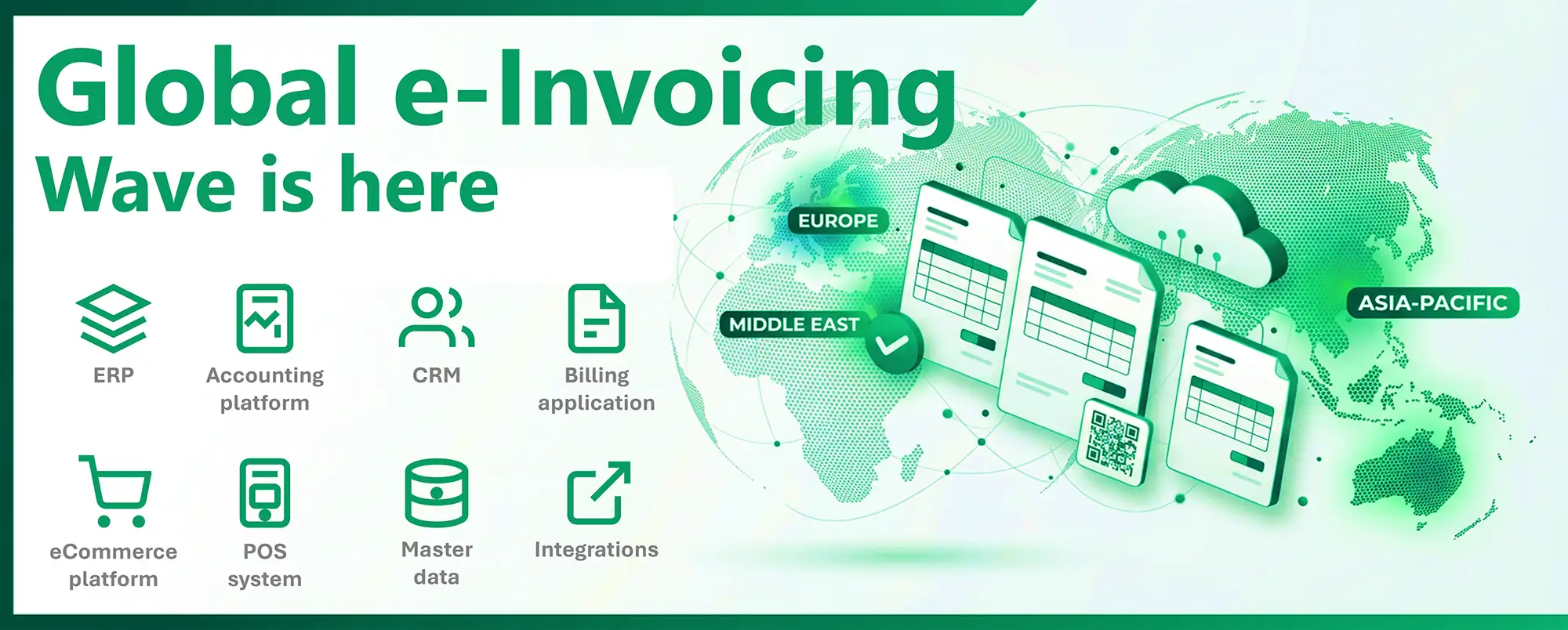
E-invoicing is no longer just a finance transformation project. It is increasingly a global compliance priority.
From Europe and the Middle East to Asia-Pacific, governments are moving away from traditional invoices and PDF-based processes toward structured, digital, and increasingly real-time invoice exchange.
For businesses operating across multiple countries, this presents a new challenge: keeping up with varying mandates, formats, timelines, tax requirements, and integration models.
2026–2027 is shaping up to be a critical period.
E-Invoicing Is Going Global
Across major markets, governments are introducing or expanding mandatory e-invoicing frameworks. Approaches vary, but the direction is clear: greater digital compliance, more structured data, and increased visibility into business transactions.
Europe: Moving Toward Structured, Connected Invoicing
Europe remains one of the most active regions for e-invoicing adoption.
Belgium and Croatia introduced major B2B requirements in 2026, while France, Poland, and Greece are implementing them in phases. Germany, Spain, Slovakia, Norway, and Estonia are among the markets businesses need to prepare for as requirements expand through 2027.
A common theme is the growing role of Peppol, EN 16931, structured invoice formats, digital reporting, and automated tax compliance.
For multinational organizations, this means that simply generating an electronic invoice is no longer enough. Business systems need to exchange the right data in the right format through the right channels.
Middle East: Real-Time Compliance Takes Center Stage
The Middle East is rapidly adopting more advanced e-invoicing and Continuous Transaction Control (CTC) models.
Saudi Arabia continues its phased FATOORAH rollout, while the UAE begins its phased e-invoicing implementation in July 2026. Oman is also beginning its phased Fatwara rollout, while Israel continues to strengthen real-time invoice validation requirements.
The direction is clear: businesses will increasingly need system integration, data validation, secure transmission, and connectivity to tax authorities or accredited service providers.
Asia Pacific: Different Markets, Different Models
The Asia-Pacific region presents a mix of mature and emerging e-invoicing frameworks.
India already operates a well-established GST e-invoicing ecosystem that uses IRP validation, IRNs, and QR codes. Malaysia and Singapore are adopting in phases, while Thailand continues its standards-led approach.
For organizations operating across the region, there is no one-size-fits-all approach. Each market may have different invoice formats, validation mechanisms, reporting requirements, and implementation timelines.
What About North America?
The US and Canada currently lack nationwide B2B e-invoicing mandates comparable to those in certain European and Asian markets.
But that doesn't mean North American businesses can ignore this trend.
Companies engaged in international trade may still need to support structured electronic invoicing when doing business with customers or entities in countries where e-invoicing is mandatory.
The Bigger Shift: E-Invoicing Is More Than a Digital Invoice
One of the biggest misconceptions is that e-invoicing simply means replacing a PDF invoice with an electronic invoice.
Modern frameworks are moving toward a connected digital workflow:
Structured Data
Validation
API Integration
Accredited Service Providers
Real-Time Reporting
Digital Audit Trails
What Should Businesses Do Now?
Instead of waiting for a mandate to become an immediate operational issue, businesses should start by assessing their current invoicing environment.
Ask:
- Can our systems generate the required structured invoice data?
- Is our customer and tax master data accurate?
- Can our ERP or accounting platform integrate with the required service providers?
- Are our APIs and integrations ready for real-time exchange?
- Can we support different requirements across multiple countries?
- Do we have the appropriate validation, monitoring, and audit processes?
Early preparation can help organizations reduce implementation risk, avoid last-minute system changes, and maintain business continuity when mandates take effect.
The Road Ahead
The global e-invoicing landscape is evolving rapidly. Some countries are already enforcing requirements, others are implementing them in phases, and several are preparing for future mandates.
For businesses, the opportunity outweighs the compliance requirement.
A well-designed e-invoicing environment can also help reduce manual processing, improve data accuracy, strengthen financial controls, accelerate invoice processing, and create a more connected digital finance operation.
The question is no longer “Will e-invoicing affect my business?”
It's:
“Is my business technology ready for the e-invoicing era?”
As regulations continue to evolve, organizations that prepare early will be better positioned to adapt, integrate, and scale with confidence.
Connect with KARYA Technologies at info@karyatech.com or visit www.karyatech.com